Otoacoustic Emissions (OAE) Test
Otoacoustic Emissions (OAE) testing is a quick, painless, and objective hearing assessment used to evaluate the function of the cochlea, particularly the activity and health of the outer hair cells located within the inner ear. These specialized sensory cells play a critical role in amplifying and processing sound vibrations, allowing the brain to accurately perceive and interpret sounds. OAE testing provides valuable information about cochlear function and is widely used for newborn hearing screening, infants, young children, and individuals who may not be able to provide reliable responses during conventional behavioral hearing tests.
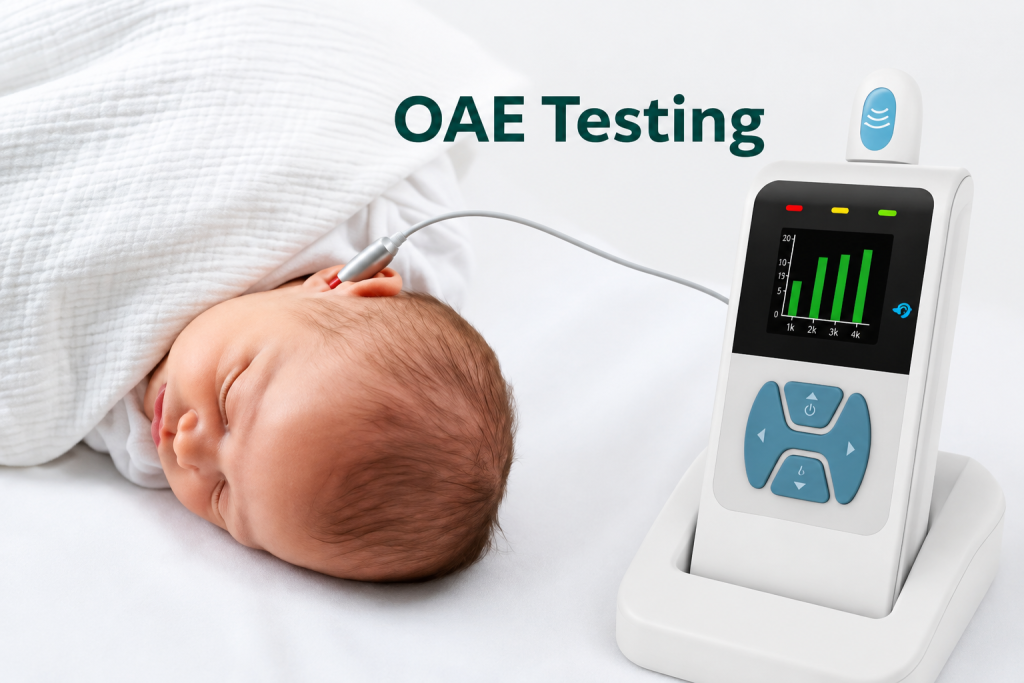
During the test, a small, soft probe containing a speaker and microphone is gently placed inside the ear canal. The probe delivers low-level sounds, such as clicks or pure tones, that stimulate the cochlea. In a normally functioning cochlea, healthy outer hair cells respond to this stimulation by creating very faint sounds known as otoacoustic emissions. These emissions travel back through the middle ear and ear canal, where they are detected and measured by the sensitive microphone inside the probe.
How the OAE Test Works
During the test, a small soft probe or foam/rubber tip is gently placed in the ear canal. The probe delivers soft sounds into the ear and a sensitive microphone records the tiny echoes produced by the cochlea.
The test is non-invasive and does not cause pain or discomfort. Children do not necessarily need to be asleep, but they should remain calm and as quiet and still as possible during the assessment to obtain accurate results.
Understanding OAE Results
- Absent OAEs: May indicate a possible hearing or middle-ear problem. This can be associated with hearing loss, earwax blockage, fluid or infection in the middle ear, or other conditions affecting the auditory system. Further testing may be recommended to determine the underlying cause.
- Present OAEs: Usually indicate that the cochlea’s outer hair cells are functioning appropriately and are generally consistent with normal or near-normal cochlear function.
All Major Cities of Pakistan
Islamabad hearing center with a team of professional audiologists, engineers, and programming experts trained in multiple countries.That’s why we are trusted by international brands
Head Office No, 7 Ground Floor Executive Complex back side PSO Pump, G-8 Markaz Islamabad,44000
Office :0300-7882573
051-8899990
Clinic No MF-72,73 Pak Medical Center, Khyber Bazaar Rd, PTCL Colony Peshawar.
Office : +92 91 2550063
Call/WhatsApp : +92 341 6888999
oppo Jazz office (Kips Academy, Satayana Rd, near Punjab Laboratory, Suhail Abad Batala Faisalabad
Office : +92 41 8846878
Mobile : +92 300 7896555
Front of Ali Imran Hospital, CMH Rd, near CMH Supply Bazar, Rawalakot
Office : +92 336 1100882
Clinic no 308, 6th Road Center Near Punjabi College, , Satellite Town, 6th road Rawalpindi.
Office : 0336-5533223
051-4913351
Oppposit City Science College, near allied hospital, bypass bagh city, azad kashmir.
Office : +92 333 5140004
Call/WhatsApp : +92 336 5784920
Shop 1 Basement, Qazi plaza, CMH Road, near chughtai Lab, Muzaffarabad
Office : +92 316 5077778
Oppo Apwa Head Quarter, Office 9 kiyani Shaheed Plaza, Afridi Shahid Rd, Saddar Karachi
Office : +92 300 7882693
Nishtar Rd, near Islamabad Diagnostic Center, opposite Dost Plaza, Lalazar Colony, Multan
Office : +92 300 8233362
Office A, 16 Main Bazar, near Sarwar Hospital, Satellite Town Sargodha
Office : +92 300 8298855
Office A, 16 Main Bazar, near Sarwar Hospital, Satellite Town Sargodha
Office : +92 300 8298855
Office A, 16 Main Bazar, near Sarwar Hospital, Satellite Town Sargodha
Office : +92 300 8298855