- Head Office No, 7 Ground Floor Executive Complex back side PSO Pump, G-8 Markaz Islamabad.
- 0300-7882573
- 051-8899990

Pure Tone Audiometry (PTA) is a comprehensive, accurate, and widely used hearing assessment designed to measure an individual’s ability to hear different sounds across a range of frequencies and intensity levels. It determines the softest sounds a person can detect at different pitches, providing a detailed evaluation of overall hearing sensitivity. PTA is considered one of the most important diagnostic tools used by audiologists to identify the presence, degree, and type of hearing loss.
Hearing loss can affect people of all ages and may develop gradually due to factors such as aging, prolonged exposure to loud noise, ear infections, medical conditions, or other changes within the auditory system. PTA helps identify even mild hearing difficulties that may otherwise go unnoticed, allowing early management and appropriate hearing care.
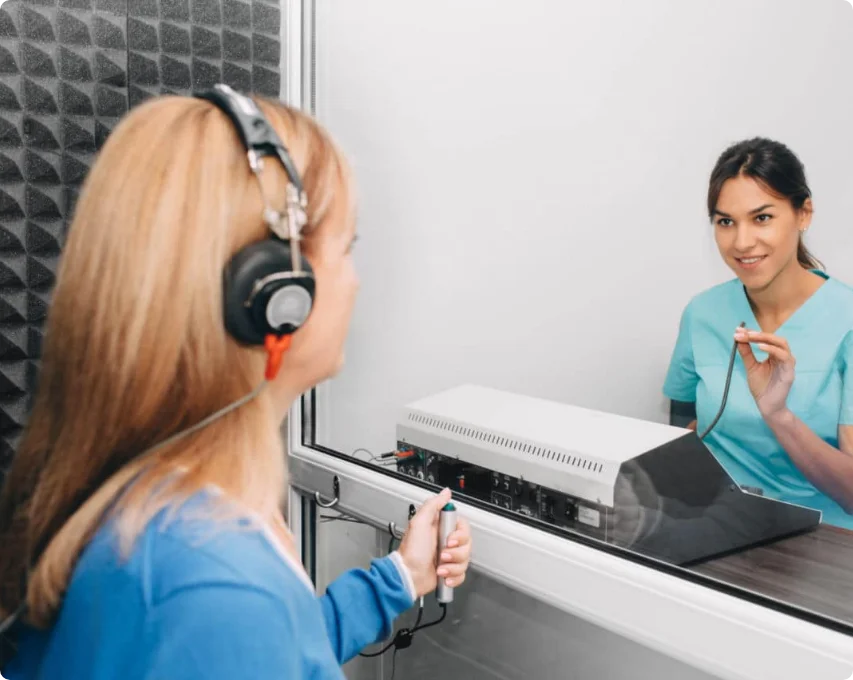
During a Pure Tone Audiometry test, the patient is seated in a quiet testing environment, and headphones or insert earphones are carefully placed over or inside the ears. Pure tones are then presented to one ear at a time at different frequencies and volume levels. The patient is asked to respond whenever they hear a sound, even if it is very soft or faint. Responses are recorded to determine the lowest level at which sounds can be detected.
The results are displayed on an audiogram, which provides a visual representation of hearing ability across different frequencies. This information allows audiologists to analyze hearing patterns and determine whether the hearing loss is conductive, sensorineural, or mixed in nature. It also helps identify whether hearing difficulties affect one ear or both ears and how they may impact everyday communication.
PTA testing is commonly recommended for individuals experiencing symptoms such as difficulty understanding speech, frequently increasing the volume of television or phones, asking others to repeat themselves, experiencing ringing in the ears (tinnitus), or noticing reduced hearing ability in noisy environments. It is also widely used for routine hearing evaluations, workplace hearing conservation programs, school screenings, and monitoring changes in hearing over time.
The results of PTA provide essential information for developing a personalized hearing care plan. Based on the findings, audiologists can recommend suitable solutions, including hearing aids, assistive listening devices, medical referrals, auditory rehabilitation, or regular hearing monitoring. Accurate hearing assessment ensures that each individual receives the most appropriate support according to their lifestyle, communication needs, and hearing goals.
At Alshifa Hearing Clinic, we perform Pure Tone Audiometry using modern audiological equipment, advanced testing methods, and professional clinical techniques to provide accurate, dependable, and patient-focused hearing evaluations. Our experienced hearing professionals carefully assess each patient’s hearing condition and guide them toward the most suitable hearing solutions at affordable rates, helping improve communication, confidence, and quality of life.
During a Pure Tone Audiometry (PTA) test, you will sit comfortably in a specially designed soundproof room to minimize outside noise and ensure accurate results. Headphones or insert earphones are placed over your ears, and you will be asked to respond whenever you hear a sound, even if it is very soft.
Different pure tones, including steady and beeping sounds, are presented at various frequencies and volume levels. The sounds are delivered to one ear at a time, and you indicate when you hear each tone. The audiologist gradually adjusts the intensity of the sounds to determine the softest level you can hear at each frequency. The procedure is then repeated for the other ear.
For bone conduction testing, the headphones are removed and a small bone-conduction device is gently positioned behind the ear. This device sends vibrations through the bones of the skull directly toward the inner ear. Comparing air and bone conduction results helps the audiologist determine whether hearing loss is related to the outer/middle ear or the inner ear.
When necessary, masking noise may be presented to the better-hearing ear to prevent it from responding to sounds intended for the poorer ear. This helps the audiologist obtain accurate, ear-specific hearing thresholds.
Speech testing may also be performed to assess how well you can hear and understand spoken words. You may listen to a series of familiar words through the earphones and repeat what you hear. This helps evaluate speech recognition ability in addition to pure-tone hearing sensitivity.
PTA provides ear-specific and frequency-specific hearing thresholds, allowing audiologists to determine the degree, configuration, and possible type of hearing loss. Comparing air-conduction and bone-conduction thresholds can reveal an air-bone gap, which is useful in distinguishing between conductive, sensorineural, and mixed hearing loss.
At Alshifa Hearing Clinic, our audiologists use advanced equipment and professional testing techniques to provide accurate and comprehensive hearing assessments.