Pure Tone Audiometry (PTA) Test

Pure Tone Audiometry (PTA) Test

Pure Tone Audiometry (PTA) is a comprehensive hearing assessment used to determine the softest sounds a person can hear across a range of frequencies. It is one of the most common and reliable tests for evaluating hearing sensitivity and identifying the degree and type of hearing loss.

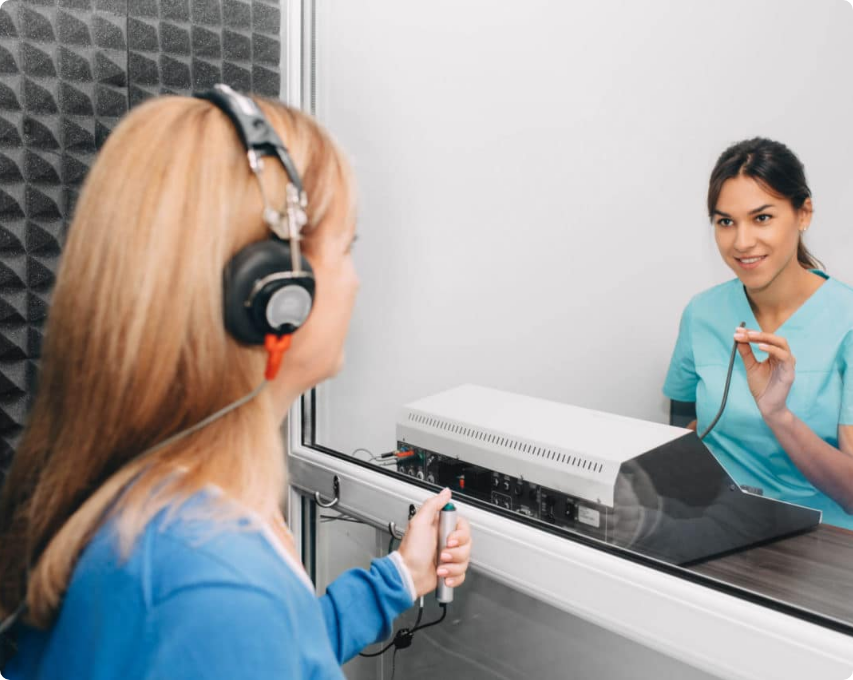
During the test, headphones or insert earphones are placed over or inside the ears, and pure tones are presented to one ear at a time at different pitches and volume levels. You will be asked to respond whenever you hear a sound, even if it is very faint.

The results help our audiologists understand your hearing ability, determine the level of hearing loss, and develop an appropriate hearing care or hearing aid recommendation based on your individual needs.

At Alshifa Hearing Clinic, we perform PTA hearing tests using modern audiological equipment and professional testing techniques to provide accurate and reliable results at affordable rates.

PTA Test Procedure

During a Pure Tone Audiometry (PTA) test, you will sit comfortably in a specially designed soundproof room to minimize outside noise and ensure accurate results. Headphones or insert earphones are placed over your ears, and you will be asked to respond whenever you hear a sound, even if it is very soft.

1. Air Conduction Testing

Different pure tones, including steady and beeping sounds, are presented at various frequencies and volume levels. The sounds are delivered to one ear at a time, and you indicate when you hear each tone. The audiologist gradually adjusts the intensity of the sounds to determine the softest level you can hear at each frequency. The procedure is then repeated for the other ear.

2. Bone Conduction Testing

For bone conduction testing, the headphones are removed and a small bone-conduction device is gently positioned behind the ear. This device sends vibrations through the bones of the skull directly toward the inner ear. Comparing air and bone conduction results helps the audiologist determine whether hearing loss is related to the outer/middle ear or the inner ear.

3. Masking Test

When necessary, masking noise may be presented to the better-hearing ear to prevent it from responding to sounds intended for the poorer ear. This helps the audiologist obtain accurate, ear-specific hearing thresholds.

4. Speech Testing

Speech testing may also be performed to assess how well you can hear and understand spoken words. You may listen to a series of familiar words through the earphones and repeat what you hear. This helps evaluate speech recognition ability in addition to pure-tone hearing sensitivity.

How PTA Helps Identify Hearing Loss

PTA provides ear-specific and frequency-specific hearing thresholds, allowing audiologists to determine the degree, configuration, and possible type of hearing loss. Comparing air-conduction and bone-conduction thresholds can reveal an air-bone gap, which is useful in distinguishing between conductive, sensorineural, and mixed hearing loss.

At Alshifa Hearing Clinic, our audiologists use advanced equipment and professional testing techniques to provide accurate and comprehensive hearing assessments.

    Etiam magna arcu, ullamcorper ut pulvinar et, ornare sit amet ligula. Aliquam vitae bibendum lorem. Cras id dui lectus. Pellentesque nec felis tristique urna lacinia sollicitudin ac ac ex. Maecenas mattis faucibus condimentum. Curabitur imperdiet felis at est posuere bibendum. Sed quis nulla tellus.

    ADDRESS

    63739 street lorem ipsum City, Country

    PHONE

    +12 (0) 345 678 9

    EMAIL

    info@company.com

    Cart